
Pharmaceutical news · Critical appraisal
Published
Anktiva: response, duration and denominators
The US expansion on 14 October raises three separate questions: who responded, how long that response lasted, and how far evidence can be carried into another population.
28 people. Two denominators.
Documented response duration of at least 12 months, in the CIS efficacy population.
Among responders
28 / 4858.3%
Over the initial CIS cohort
28 / 7736.4%
A regulatory decision can draw on a body of evidence without turning every trial percentage into a benefit estimate for every patient. Anktiva provides a practical example of why denominators, uncertainty and the limits of studies without a comparator belong in the same account.
1. What happened and which population is added
On 14 October 2026, the FDA expanded Anktiva, nogapendekin alfa inbakicept-pmln, with BCG to adults with BCG-unresponsive, high-grade, papillary-only non-muscle-invasive bladder cancer. Carcinoma in situ, or CIS, was already covered by the previous indication, with or without papillary tumours. Papillary disease without CIS is the newly added population. FDA release, 14 October.
The decision date is separate from the trial timeline. Initial US approval was on 22 April 2024. The original QUILT-3.032 article was published online on 10 November 2022 and appeared in the January 2023 issue of NEJM Evidence. Keeping these dates apart prevents established observations from being presented as newly generated results. Initial approval · Original article.
2. Why clinical context changes the statistical question
CIS forms flat lesions, whereas papillary tumours grow into the bladder cavity. The FDA describes shared clinical and biological features, frequent coexistence, and risks of recurrence and progression after BCG stops controlling the disease. Those similarities support its reasoning for carrying evidence across the two forms. The agency’s explanation.
Methodologically, the starting state matters as much as the disease label. Documenting disappearance of existing disease and documenting absence of a new recurrence following resection answer different questions. A response proportion and a probability of remaining disease-free require definitions, time origins and populations that cannot be exchanged casually. The FDA guidance on oncology endpoints provides context for distinguishing the measures.
3. Which quantitative evidence the expansion cites
The October technical notice refers back to cohort A of QUILT-3.032, a multicentre, single-arm study. Its efficacy population comprised 77 people with CIS, with or without Ta/T1 papillary disease. The FDA reports a 62% complete response rate, with a 95% confidence interval of 51% to 73%. Among responders, 58% had response duration of at least 12 months and 40% of at least 24 months. FDA technical notice.
These percentages describe the CIS population supporting the previous evidence. They are not a newly observed 62% response estimate for papillary-only disease. Nor is there a randomised comparison against BCG alone. Simply subtracting percentages cannot provide the risk difference attributable to adding Anktiva when the required comparator is absent.
Complete response required a negative cystoscopy, with resection or biopsies where applicable, and negative urinary cytology. The endpoint was response at any time, rather than necessarily at a shared visit. Assessments were performed every three months during the first two years. The assessment rule and opportunity to detect a response are part of what the percentage means. Definition and follow-up in the initial approval.
The descriptive question concerns response under the administered regimen and the study’s assessment rules. A different, causal question asks how response would change relative to a defined alternative in comparable people. More decimal places, or a narrower interval, cannot supply the missing counterfactual outcome needed for that comparison.
4. Three percentages using two denominators
The public record for the initial approval supplies the underlying counts: 48 responses among 77 people, with 28 of those 48 lasting at least 12 months and 19 lasting at least 24 months. The latter two quantities condition on having responded. FDA Drug Trials Snapshot, Tables 2 and 3.
| Quantity | Numerator / denominator | Percentage |
|---|---|---|
| Complete response at any time | 48 / 77 | 62.3% |
| Duration ≥12 months among responders | 28 / 48 | 58.3% |
| Duration ≥24 months among responders | 19 / 48 | 39.6% |
| Documented ≥12-month count over all 77 people | 28 / 77 | 36.4% |
The identity (48/77) × (28/48) = 28/77 exposes the denominator change. The 36.4% value is our arithmetic transformation of the documented count. It is not a Kaplan–Meier estimate, a response rate at a fixed visit, or the probability of being cancer-free 12 months after treatment starts. Duration begins when response is achieved, and responses do not all begin on the same date.
Incomplete follow-up can also leave responses without sufficient observation to reach a duration threshold. Counting what is documented and estimating a time distribution with censoring are different operations. Multiplying rounded percentages gives only an approximation. Using counts preserves the exact arithmetic but does not resolve follow-up limitations.
5. What a confidence interval adds and leaves unresolved
Recalculating 48/77 using the exact Clopper–Pearson binomial interval gives 62.34%, with a 95% confidence interval of 50.56% to 73.13%. Rounded values agree with the regulatory presentation. This is a numerical check of an aggregate result, not an analysis of individual records or a new efficacy assessment. The guide includes code using stats::binom.test.
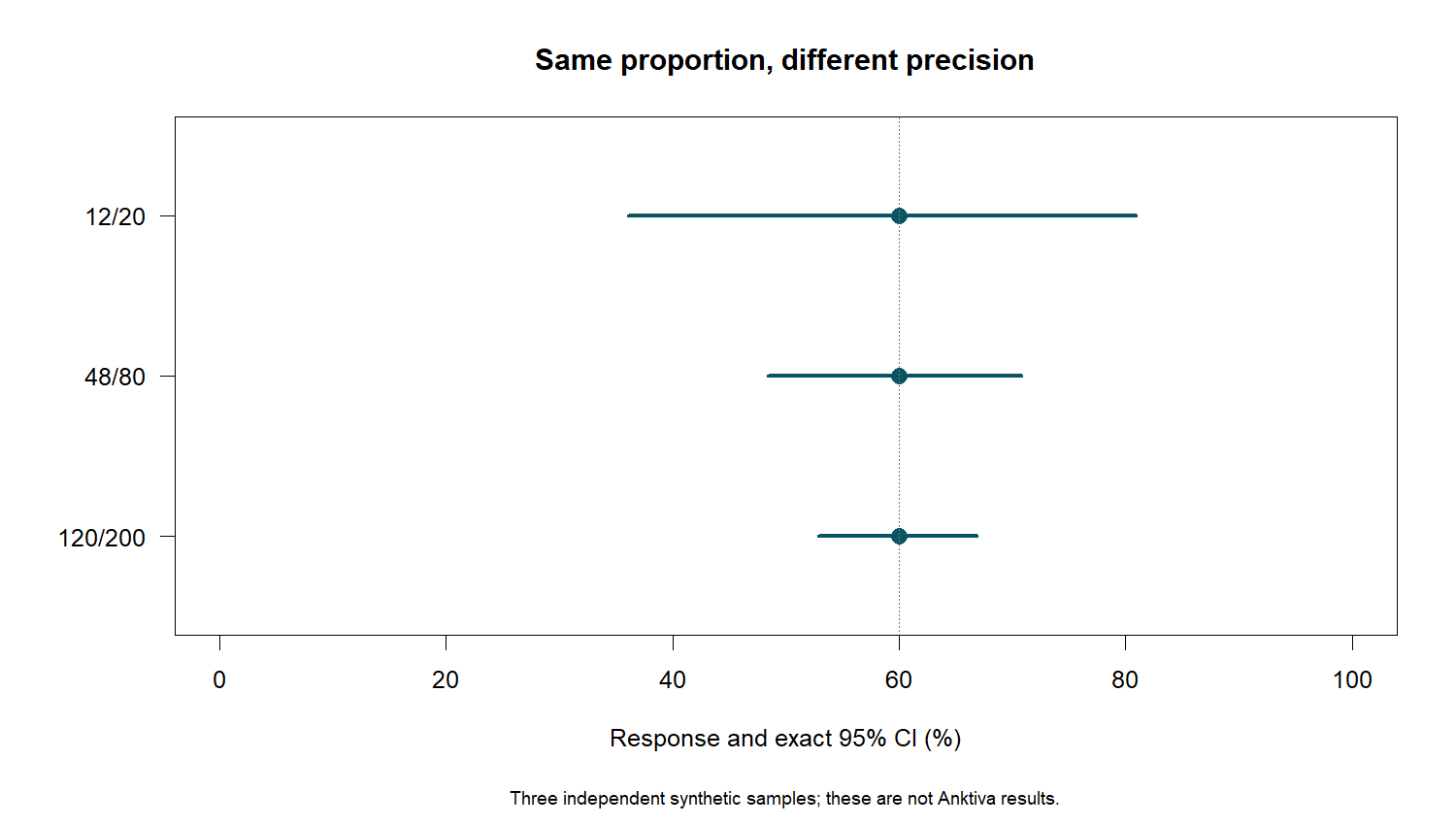
The interval addresses sampling uncertainty under a binomial model. It does not automatically absorb selection bias, response misclassification, centre differences or limited transportability. Two studies can have overlapping intervals and still be incomparable by design. A response percentage also differs from the percentage of people whose responses were caused solely by one component of a combination.
6. Extrapolation needs an explicit argument
The FDA states that overlapping clinical and non-clinical features allow the prior demonstration of efficacy in CIS to be extended to high-grade papillary disease. This is the public rationale for the expanded indication. It does not mean that all response probabilities are identical between the populations. Regulatory reasoning.
Our proposed reading framework separates the source population, target population and outcome of interest. It then asks which differences could modify effects: residual disease, previous treatment, assessment rules and clinical practice. A plausible shared mechanism helps formulate the argument. On its own, it neither converts a clinical series into a randomised trial nor eliminates uncertainty about application.
The disease-specific development guidance page still identified the August 2024 document as a draft, not for implementation, when checked. The FDA said it was working towards finalisation. This article therefore announces neither a newly finalised guidance nor a universal rule that any single-arm study is sufficient for any indication. FDA document status.
7. Response, survival and bladder preservation
These are relevant outcomes answering different questions. Cystectomy also depends on clinical decisions, preferences and disease evolution. Restricting a later analysis to responders selects people using something that happened after treatment. Even a correct description within that selected group does not by itself quantify how the outcome would change under another treatment.
This distinction had a concrete application: in a January 2026 letter, the FDA challenged attribution of benefits in cystectomy avoidance and disease-specific survival to Anktiva using QUILT-3.032 without a comparator. The agency closed that action on 27 January after evaluating the company’s response. This is methodological context, not a claim that the cited matter remains unresolved. 7 January letter · 27 January close-out.
8. Safety, applicability and jurisdiction
US product information describes urinary and other adverse reactions and warns that delaying cystectomy can lead to potentially fatal metastatic disease. Benefits should be read alongside harms and clinical surveillance. These data do not provide a randomised estimate of excess toxicity compared with BCG alone. 2024 US label, historical safety source.
The expansion discussed here is a US decision. The EMA record checked still lists CIS with or without papillary tumours and a conditional authorisation from February 2026. The FDA announcement should not be turned into a European expansion or a statement about Spanish availability or reimbursement; those require their own current sources. EMA indication and authorisation.
9. Turn the headline into a reproducible check
The related practical guide recalculates the 48/77 interval, reconstructs denominators and explores missing responses. Its synthetic example contains 100 people: 60 responses, 30 non-responses and 10 unknown outcomes. Restricting analysis to the 90 observed outcomes gives 66.7%; completing the ten unknown values produces sample proportions from 60% to 70% across all 100. This range describes possible sample completions, not a 95% confidence interval.
The aim is to check a claim before repeating it. A useful result statement identifies who enters the denominator, how response is defined, when the clock starts and which comparison exists. If one piece is missing, the wording should preserve that uncertainty. Anktiva is more informative when the regulatory decision, its supporting evidence and the design’s limitations remain visible together.